



Overview: Turning Disruption into a Managed Variable
Saudi Arabia’s new remote learning trigger policy for the 1447 academic year does something deceptively simple: it converts school disruption from a discretionary, last minute judgment call into a rules based operational regime tied to explicit health and climate thresholds. When those thresholds are crossed, in person schooling stops but instruction does not. The system pivots to Madrasati and other national platforms by default, not debate.
For investors in Saudi education, digital infrastructure, and social outcomes strategies, this is not a marginal regulatory tweak. It is an embedded demand signal for resilient digital learning rails devices, platforms, connectivity, content, and analytics that can absorb shocks from heatwaves, sandstorms, flooding, or localized outbreaks without allowing learning losses to compound. It also reshapes how to think about education as an asset: less as a binary “open vs closed” service, more as a continuity of learning system with measurable uptime, latency, and quality.
This article frames the new policy in four layers: the global disruption and learning loss context; regional exposure to climate and health shocks; Saudi Arabia’s specific digital education baseline; and then the challenges, solutions, and benefits that matter for capital allocation.
The Global Context: Climate, Closures, and Measurable Learning Loss
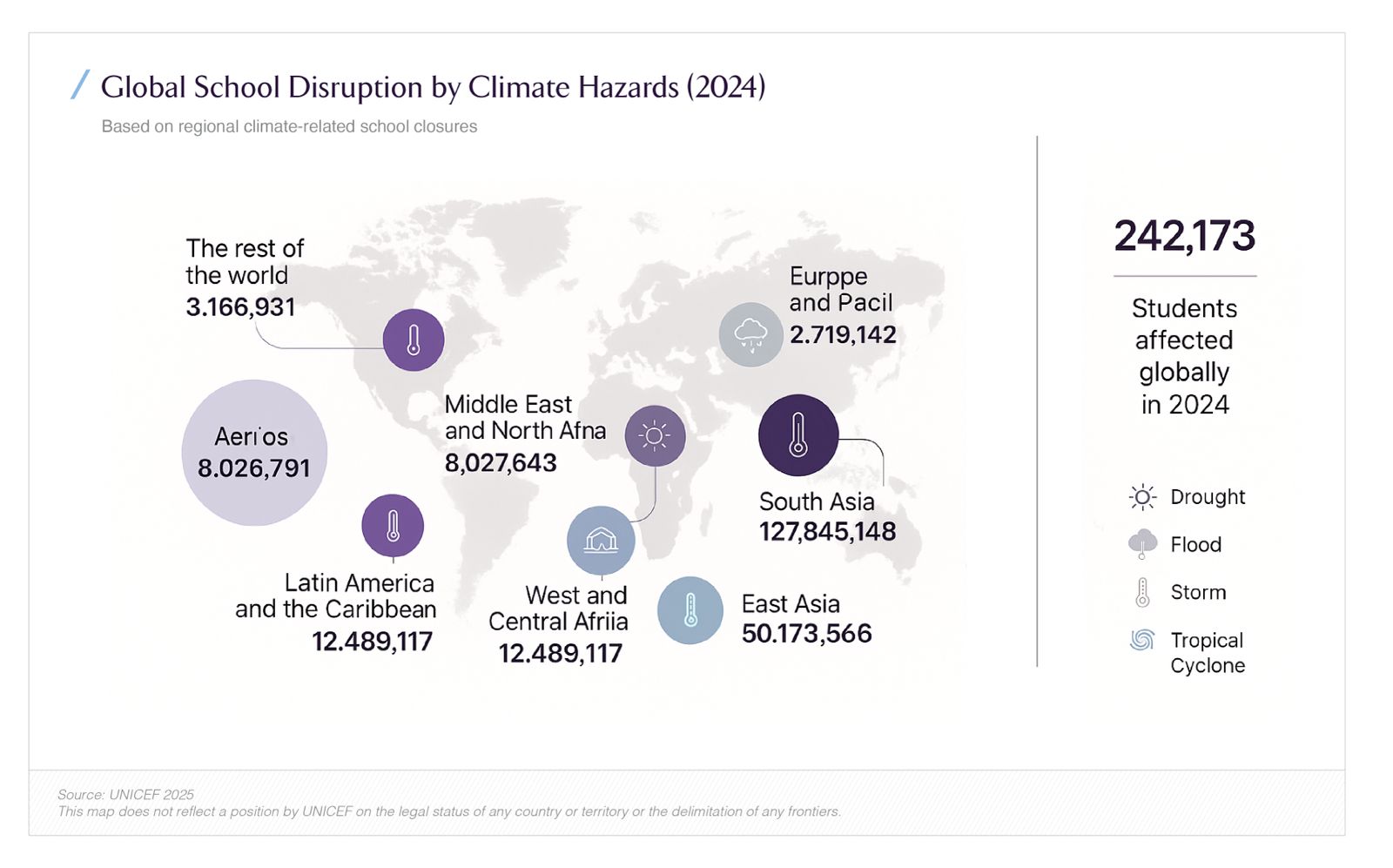
Globally, the new Saudi regime is landing into an environment where schooling is increasingly disrupted by non-financial shocks. UNICEF’s 2025 Learning Interrupted snapshot estimates that at least 242 million students across 85 countries had their schooling disrupted by climate hazards in 2024 alone, roughly 1 in 7 students worldwide. Heatwaves, tropical cyclones, storms, floods, and droughts drove nationwide or regional suspensions of in person learning, often repeatedly within a single year.
Within that, heatwaves were the dominant driver, affecting an estimated 171 million students in 2024, with April alone seeing disruptions for 118 million children across Bangladesh, Cambodia, India, the Philippines, and Thailand. For education systems that lack robust remote learning rails, those closures translate directly into lost instructional time and cumulative learning deficits.
Alongside exposure, the magnitude of learning loss is now better quantified. A 2025 global analysis using PISA data finds that mathematics scores declined by an average of 14% of a standard deviation relative to pre-pandemic trends roughly seven months of learning lost. Losses were substantially higher in systems that faced longer closures and in schools serving disadvantaged students.
Critically for investors thinking in terms of system design rather than “COVID nostalgia,” the same work and associated meta analyses show that:
- Losses are not linear: beyond a certain threshold of closure time, deficits grow faster than time out of school.
- Systems with pre existing digital infrastructure and clear remote learning protocols experienced smaller losses, even with similar closure durations.
- Recovery is slow and uneven without targeted interventions, test scores in many systems are not rebounding to pre 2020 trajectories.
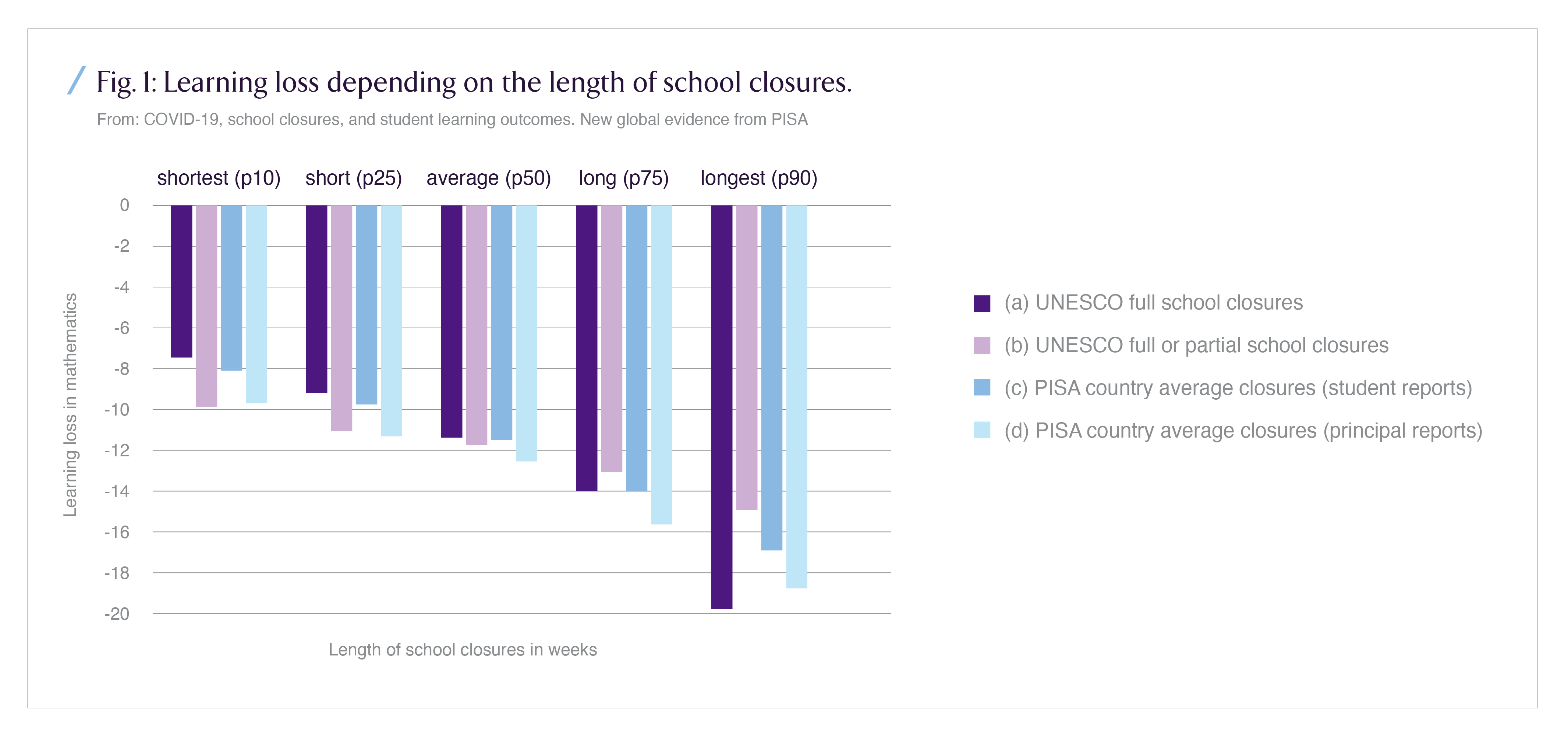
From an asset allocation perspective, these two charts one on climate induced disruption, one on learning loss define the problem the Saudi policy is trying to solve: the world is facing more frequent and intense triggers for closure, and the cost of not having resilient remote learning infrastructure is now quantifiable in terms of human capital and long run income.
Regional Landscape: MENA’s Exposure and the Case for Adaptive Schooling
The Middle East and North Africa region sits at the intersection of climate and demography: young populations, high urbanization, and growing exposure to extreme heat, storms, and flooding. UNICEF’s climate disruption snapshot highlights that over 8 million students in MENA saw their schooling disrupted by climate hazards in 2024, largely due to storms and floods, with heat as an increasingly important driver.
In parallel, emerging evidence on climate and education suggests:
- Heat related learning losses can accumulate to as much as 1.5 years of schooling equivalent over a child’s school career without adaptation.
- Extreme weather events in 2024 alone disrupted schooling for ~242 million children globally, with a disproportionate share in low and middle income countries.
For GCC states, the near term pressure point is extreme heat and dust storms rather than tropical cyclones. The policy response across the region has been heterogeneous: ad hoc closures announced via local media, partial calendar adjustments, or limited pilots in blended learning. Few countries have moved to a fully codified, threshold based, remote learning switch accessible to school level leadership.
Against that backdrop, Saudi Arabia’s decision to formalize triggers and default to remote learning moves the Kingdom towards the frontier of “adaptive schooling” where health and climate risk are explicitly priced into the operating model of education systems, not managed as exceptions.
Saudi Landscape: Digital Capacity Meets Rules Based Triggers
Madrasati as a System Level Rail
Saudi Arabia’s remote learning trigger is only credible because the underlying digital rails are already at national scale. The Madrasati platform launched in 2020 as an emergency response has since evolved into a core component of the country’s education infrastructure. As of 2025, Madrasati supports:
- Over 6 million students
- More than 525,000 teachers
- Around 250,000 virtual classrooms daily
- An estimated 98% reach rate across target users
The platform layers Microsoft Teams for live classes with a national content library of more than 45,000 multimedia resources and over 100,000 interactive assessment items, plus analytics capabilities that give educators and administrators a view of engagement and performance.
In other words, the Kingdom already runs one of the largest digital school systems globally. The new policy is about how and when that system is invoked, not whether it exists.
Explicit Trigger Policy for 1447
For the 1447 academic year (2025/26), the Ministry of Education has issued a ministerial order that defines scientifically anchored, quantifiable triggers for suspending in person schooling and shifting to remote learning. Examples include:
- Extreme heat: temperatures of 51°C or higher
- Heavy rain / flooding: rainfall of 10–50 mm per hour or more
- Severe cold: temperatures at or below –7°C
- Low visibility: visibility ≤1 km due to dense fog, dust, or suspended particulates
- Severe winds: speeds of ≥60 km/h
- Coastal hazards: sea waves exceeding 3 meters for coastal schools
- Infectious disease outbreaks: where the Ministry of Health confirms epidemics or dangerous contagious diseases affecting school communities
The critical design choices are:
- Decisions can be taken by regional education directorates and school principals in coordination with meteorological and civil defence authorities; they are no longer purely central and ad hoc.
- “Suspension” explicitly does not mean a holiday, it means a mandatory, immediate pivot to remote learning via Madrasati and other approved platforms, with attendance and exams treated as normal.
This reduces policy uncertainty for parents, teachers, and students, and creates a predictable operating environment for digital education vendors and infrastructure providers.
The EdTech and Digital Infrastructure Demand Signal
Underneath the policy, the Saudi digital education and e learning market is already scaling. One recent market assessment pegs the Saudi digital education and e-learning market at USD ~245 million (base year 2024), driven by high internet penetration, Vision 2030 investments, and the integration of digital tools in K 12.
A separate forecast puts the e-learning market at USD 2.4 billion in 2024, with expectations of USD 7.0 billion by 2033 at a 12.7% CAGR, reflecting both K 12 and corporate/continuing education demand.
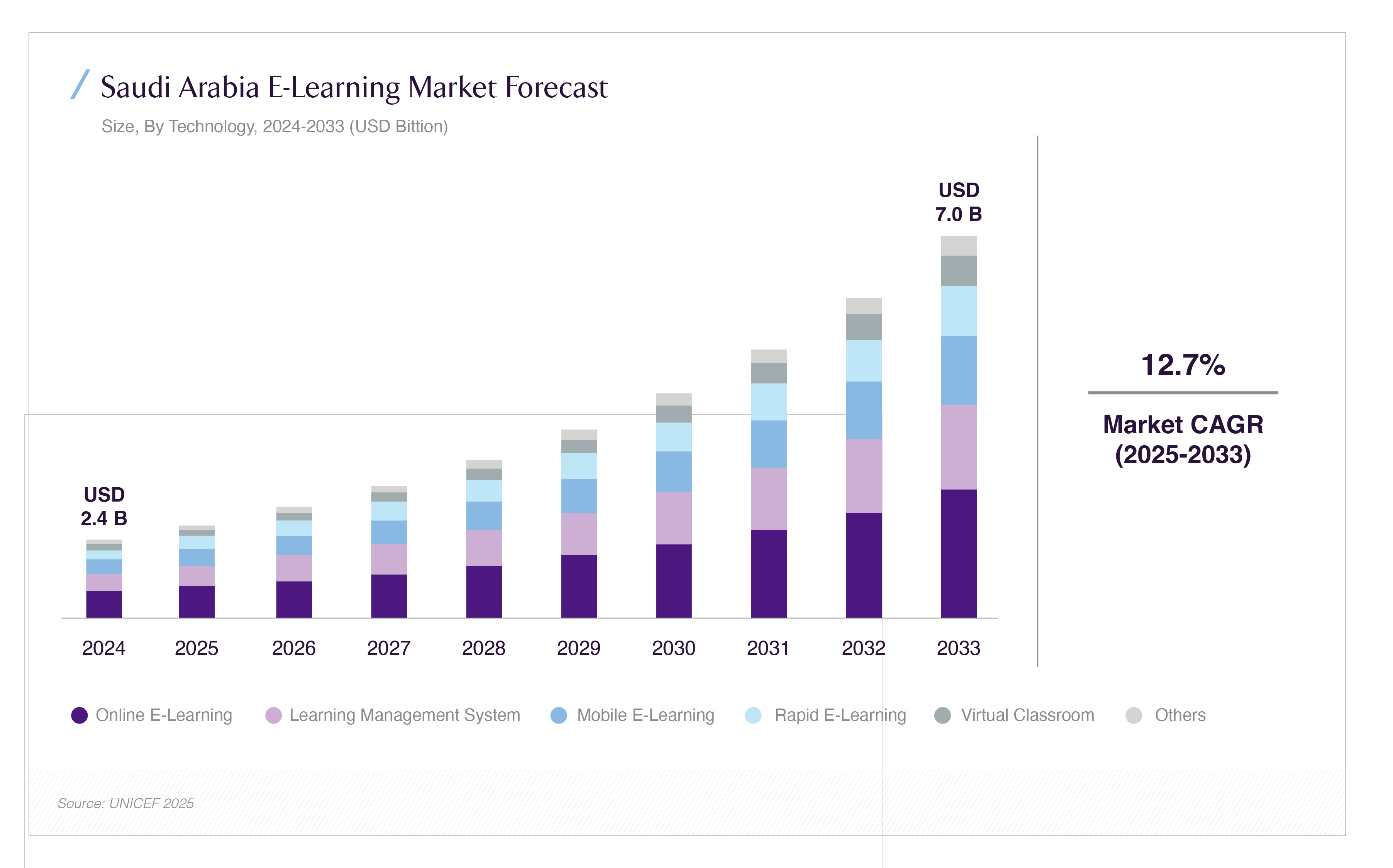
The rent freezing of physical classrooms on bad weather or outbreak days, coupled with a digital “always on” mandate, effectively pushes a portion of the country’s education delivery volume through these digital pipes on a recurring basis. That creates:
- Visibility on recurring digital usage patterns (by geography, school type, and socio economic segment).
- A natural laboratory for testing adaptive learning tools, AI assisted instruction, and data driven interventions.
- A clearer business case for telco education partnerships, device financing models, and cloud and content capacity dedicated to public education.
Challenges: Execution, Equity, and Data Quality
The opportunity is large, but the policy also raises non trivial execution challenges that investors and policymakers alike should price in.
- Equitable Access and Digital Literacy
While internet penetration is high nationally, estimates suggest that around 13% of rural areas still face inadequate connectivity and technological infrastructure. Digital literacy gaps affect roughly 28% of the population, particularly older caregivers and families in remote areas. In a regime where “school day” now implies remote login even during storms or outbreaks, these gaps risk widening learning outcomes between urban and rural students. - Pedagogical Consistency in Remote Mode
Remote learning effectiveness is highly variable across subjects, grades, and school types. Without clear standards for synchronous teaching time, assignment design, and assessment integrity during remote days, the same triggers that protect physical safety could still erode learning quality in certain segments. - Operational Load on Principals and Teachers
The new policy intentionally pushes decision making closer to the school. That agility comes with operational overhead: schools must align with meteorological alerts, communicate swiftly with parents, execute the transition to remote classes, and monitor attendance and engagement in some cases with only hours of lead time. - Data and Measurement Issues
For capital allocators who want to tie exposure to measurable impact, the most important layer is the least mature: granular, real time data on how much learning is actually preserved during remote days versus counterfactual closures. Linking Madrasati usage logs, assessment outcomes, and trigger events (e.g., sandstorms, heatwaves, localized outbreaks) requires a level of data architecture and governance that many systems are still building.
Solutions and Investment Pathways: From Policy to Bankable Infrastructure
From an investor’s lens, Saudi Arabia’s adaptive schooling regime opens several concrete solution pathways.
1. Connectivity and Edge Infrastructure
To make triggers credible in the most vulnerable geographies, there is a strong case for targeted connectivity and device interventions:
- Extending reliable broadband and 4G/5G coverage to the ~13% of rural areas still facing infrastructure limitations.
- School anchored edge computing or caching solutions that can sustain synchronous and asynchronous learning during national scale heatwaves or storms, even under strained networks.
- Device financing schemes, potentially blended with social impact capital, to ensure that each household can actually log in during remote days rather than rely on shared or intermittent access.
These are natural fields for telcos, tower cos, and infra funds already active in Saudi digital infrastructure; the difference is that returns are now supported by a codified demand model (remote days are not optional) rather than discretionary adoption.
2. Digital Platforms, Content, and Analytics
Madrasati and allied platforms provide the backbone, but there is still room for:
- Adaptive learning engines tuned for short, intense bursts of remote use during closures, with algorithms that adjust to the stress and distraction heavy context of extreme weather days.
- Content designed specifically for remote continuity, emphasizing concepts and practice with the highest marginal learning value when in person time is constrained.
- Analytics overlays that integrate system level triggers (e.g., heatwave alerts, MOH outbreak notifications) with engagement, attendance, and assessment data to produce continuity of learning KPIs: percentage of curriculum covered, learning loss avoided, and differential impacts by region.
These capabilities lend themselves to SaaS style revenue models, often with government or PPP style contracts and strong observability for impact linked financing.
3. Climate Resilient Education as an ESG Theme
UNICEF’s climate disruption analysis underscores that education is both heavily exposed to climate risk and under-represented in climate finance portfolios. Saudi Arabia’s trigger policy, combined with explicit use of digital platforms and high capex Vision 2030 investments, creates a structured pipeline of:
- School retrofits and new builds designed for extreme heat and storms (e.g., cooling, shading, flood mitigation).
- Digital and physical resilience measures that can be packaged into green, sustainability linked, or outcome based instruments, where coupon step downs or bonuses are tied to continuity of learning metrics rather than just input spending.
For regional and global investors looking for real economy, social outcome exposure in Saudi Arabia beyond healthcare and housing, adaptive schooling is a credible new theme.
Benefits: What Saudi Gains by Making Remote the Default Alternative
If executed well, the benefits of the new policy accrue along three dimensions.
- Learning Continuity and Human Capital Preservation
The global PISA evidence is clear: learning losses grow with closure duration and are not naturally self correcting. By turning every closure into an immediate remote day, Saudi Arabia aims to compress the “lost time” window and keep learning trajectories closer to baseline even as climate and health shocks intensify. - System Resilience and Policy Credibility
Clear thresholds for suspension, coupled with an operationally tested platform like Madrasati, reduce uncertainty for families and educators. They also enhance the credibility of the education system as a whole: exams and academic calendars are less exposed to random weather or outbreak shocks, which matters for everything from household planning to high stakes transitions into higher education and the labour market. - A Scalable Model for the Region
As MENA grapples with heat, storms, and flood related disruptions, a large scale demonstration that adaptive schooling can work technically, operationally, and financially positions Saudi Arabia as a reference market. That carries soft power benefits and creates exportable capabilities for local edtech firms, infrastructure players, and advisory platforms.
Recap: From Ad Hoc Closures to an Investable Continuity Framework
Saudi Arabia’s new remote learning trigger policy is best understood as an operating system upgrade for public education. It moves the country from ad hoc, media driven closure announcements to a rules based, data driven adaptive schooling model, underpinned by national scale digital infrastructure.
Globally, climate and health shocks are already disrupting hundreds of millions of students and eroding learning outcomes; the Saudi response takes those shocks as a given and designs around them. By formalizing thresholds, defaulting to remote learning, and leveraging an at scale platform like Madrasati, the Kingdom is creating both an educational resilience mechanism and an investable demand floor for connectivity, platforms, content, and analytics.
For investors, the key is to treat this not as a short term news item but as part of a broader structural thesis: human capital in Saudi Arabia is being managed with the same emphasis on continuity, redundancy, and data that one would expect in critical infrastructure. Adaptive schooling is where climate risk, digital transformation, and long run productivity converge now with a concrete policy spine to underwrite capital deployment.








.svg)
