


Saudi Arabia’s hospitality market is now too large and too operationally dense to rely on informal expectations. The “20-hour stay” rule is a national standard intended to remove the single most common ambiguity in hotel transactions: what, exactly, the guest purchased when they booked “one night.”
The Ministry of Tourism’s consumer-rights guidance for tourism accommodation states that check-in and check-out times are not fixed by regulation, but the minimum occupancy time across the check-in and check-out days must not be less than 20 hours, and that entitlement must be stated in the facility policy and reflected through the booking documentation. It explicitly positions the mechanism as enforceable: if the standard is violated, the guest can file a complaint.
In August 2025, Saudi media coverage quoting the ministry reinforced the operational point that turns the rule from principle into practice: late arrival does not shift the predetermined check-out time shown on the reservation document, even if a guest “loses hours” due to a late check-in. Hotels may set their own check-in/out schedules, but the interval must remain ≥20 hours, and those times must be clearly specified in the reservation document.
This is not a brand or operator story. It is a market-structure move designed to standardize the “unit of value” in lodging, reduce disputes about fairness, and raise operational consistency in a sector expanding rapidly across Riyadh, the holy cities, and emerging destinations.
Current global landscape
The global hotel business has always been a contract disguised as a room key. The room itself is not the product; the product is time-bounded access to inventory that must be turned, cleaned, inspected, and resold every day. That daily reset/housekeeping windows, staff shift structures, maintenance routines, and arrival/departure peaks is why hotels historically converged on predictable check-in and check-out rhythms.
What has changed internationally is not the operational logic, but consumer expectations and enforcement channels. Online travel agencies (OTAs) and review platforms have moved service disputes from front-desk conversations into public ratings, chargebacks, and regulatory escalation. In parallel, dynamic pricing has made guests more sensitive to perceived value: when rates fluctuate materially by hour or by day, the “night” concept becomes more contested unless the entitlement is clearly defined.
The Saudi approach aligns with this global direction: reduce ambiguity, anchor the transaction to a documented entitlement, and provide a complaint pathway that does not depend on a guest’s willingness to argue at check-out. The Ministry’s A360 guidance explicitly links service evaluation and post-stay feedback to booking platforms and to formal escalation through the Unified Tourism Call Center (930), positioning standards and enforcement as part of the customer journey, not an afterthought.
Current regional landscape
Across the GCC, hospitality is increasingly treated as economic infrastructure rather than discretionary leisure. That shift has two practical consequences that matter for disputes and consumer protection:
- More first-time tourists enter the system. First-timers are less tolerant of ambiguity and more likely to interpret unclear check-in/out practices as unfairness or “hidden value extraction.”
- More peak-load pressure hits hotels during events, religious seasons, and convention cycles. Under peak load, operational predictability becomes a safety and service-quality issue, not merely a revenue optimization lever.
Saudi’s broader tourism strategy also signals a widening of the target market beyond ultra-luxury toward mid-market and upper-mid-market supply, especially to support religious travel and broader affordability.
As the market widens, consumer-protection rules matter more, because the customer base becomes more heterogeneous, different nationalities, booking channels, arrival times, and expectations of “what one night means.”
The 20-hour rule should be read through that lens: a standardization tool that scales as the market scales.
Saudi landscape
The operating reality in 2025: utilization, pricing, and rapid licensing growth
By Q3 2025, official statistics illustrate why Saudi is tightening consumer-protection and operational standards now because the underlying market is expanding fast while performance metrics remain mixed.
GASTAT’s Tourism Establishments Statistics for Q3 of 2025 report that:
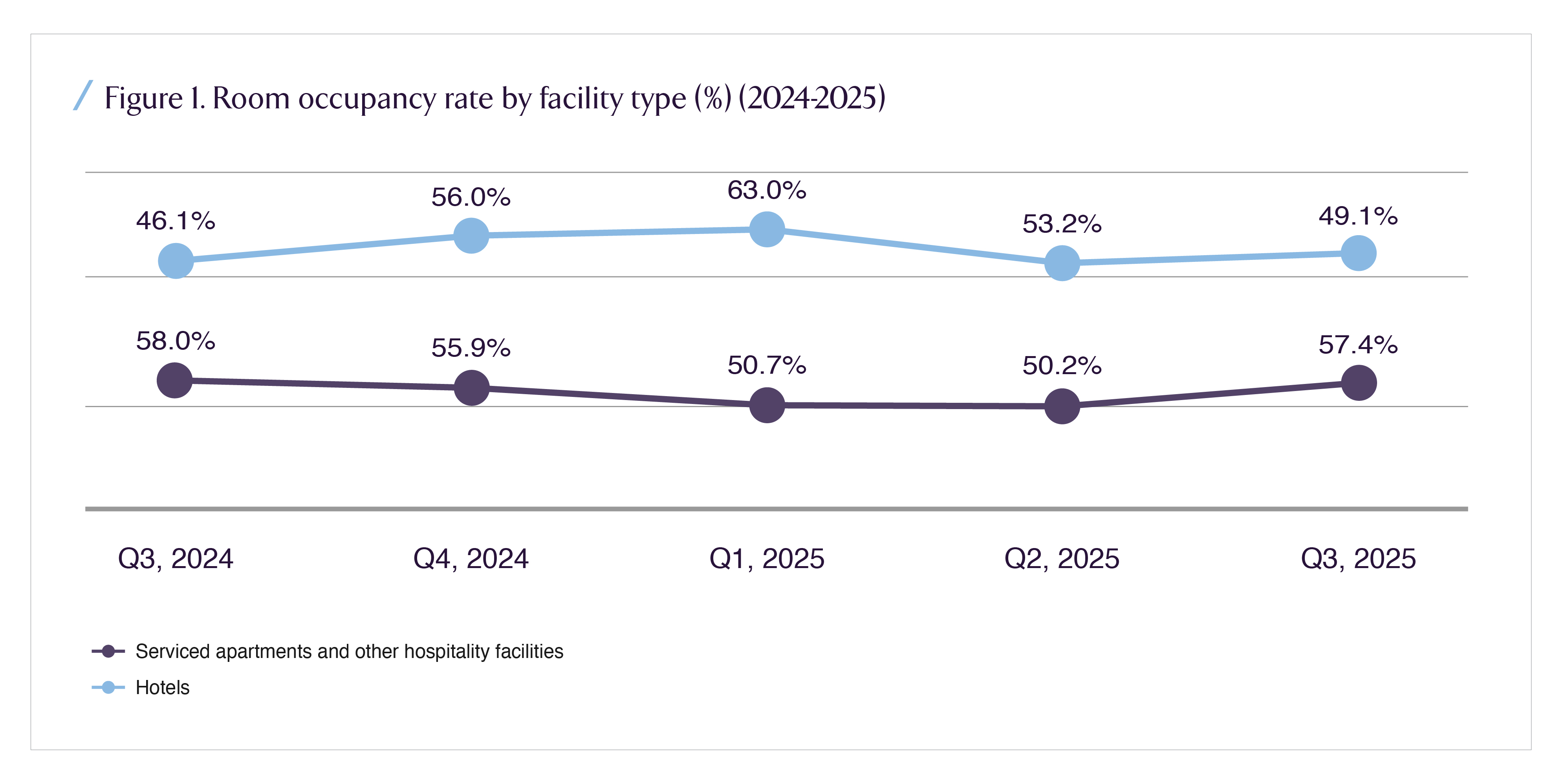
- Hotel room occupancy reached 49.1% in Q3 2025 (up 2.9 percentage points YoY).
- Serviced apartments and other hospitality facilities showed 57.4% occupancy (slightly down YoY).
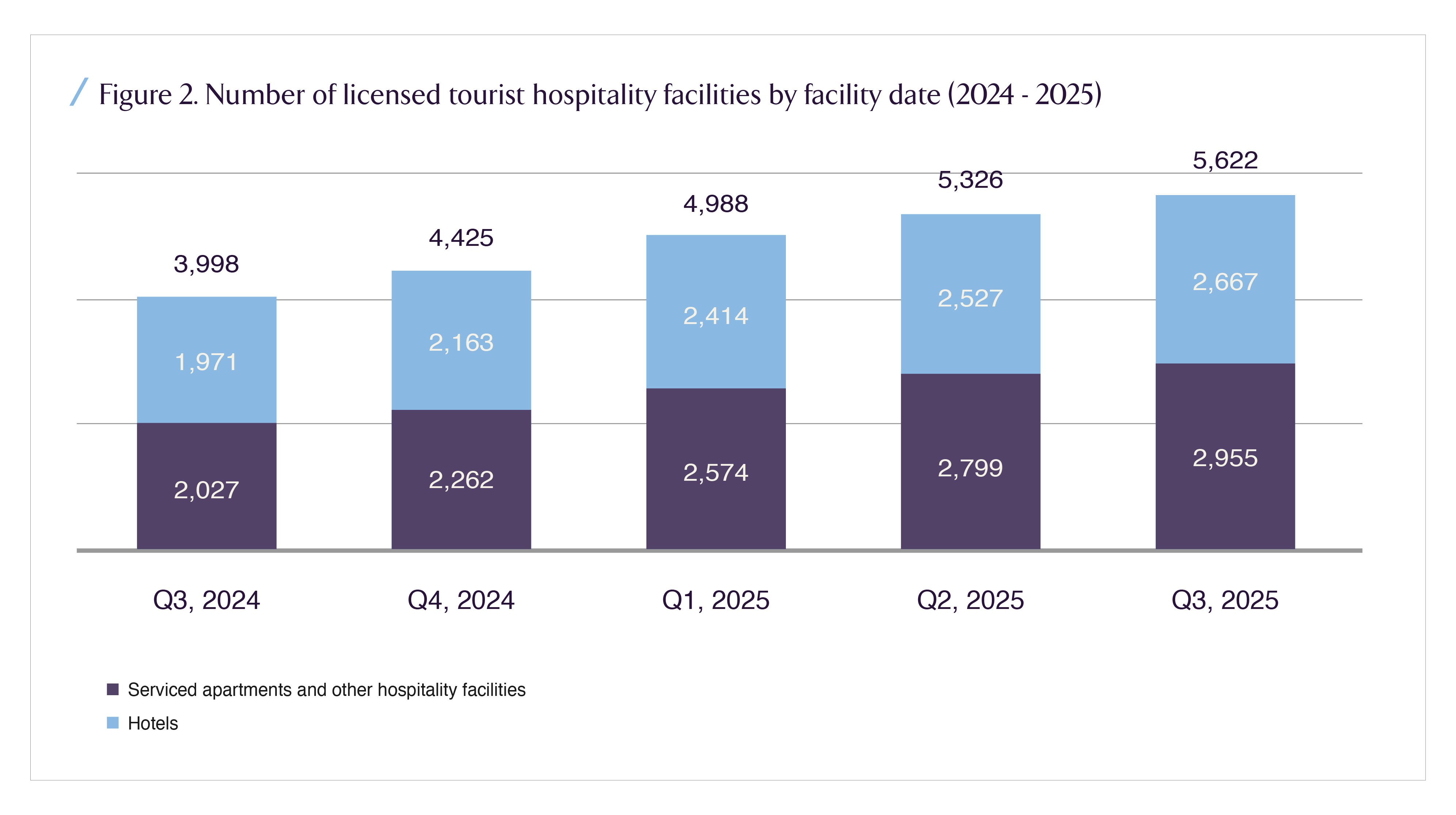
- The total number of licensed tourism hospitality facilities reached 5,622 in Q3 2025, up 40.6% year-on-year.
- Average daily room rate (ADR) for hotels was SAR 341 in Q3 2025, down 3.6% year-on-year.
This combination, rising utilization, falling ADR, and rapidly expanding facility count creates a predictable dispute environment. When rates compress and competition rises, hotels become more aggressive on fee structures, deposits, upgrade policies, and “value delivery.” When utilization rises, housekeeping windows tighten, and any expectation of “flexibility” becomes harder to honor without affecting the next guest. The 20-hour rule is designed to put those tensions inside a standardized contract, reducing argument space.

What the “20-hour stay” rule actually standardizes
Saudi’s consumer-rights guidance is unusually explicit for a hospitality market: it does not mandate a universal check-in time or check-out time, but it mandates a minimum time entitlement (20 hours) across the check-in and check-out days, and it requires the property to state the check-in and check-out times in its policy and booking documentation.
Saudi media reporting quoting the ministry adds a second layer that matters operationally: late arrival does not entitle the guest to push the pre-stated check-out time. If a guest checks in late and the reservation shows a fixed check-out time, the check-out time remains fixed.
Taken together, the standard is not about “more flexibility.” It is about less ambiguity. It defines:
- what the guest can expect (a minimum time entitlement and transparency of times), and
- what the hotel can operationalize (fixed daily turnover windows that do not get renegotiated at midnight).
Why this is a market-structure move, not a service tweak
Disputes in hotels tend to cluster around a few predictable friction points: late check-in, early check-out, deposits, hidden fees, and mismatches between listing photos and delivered room types. Saudi’s A360 guidance addresses several of these systematically:
- The facility must specify check-in/out times and ensure the minimum 20 hours.
- Facilities are prohibited from charging a guest’s card after checkout once the invoice is closed.
- Facilities must provide a price list (Arabic and English) itemizing fees and taxes, and violations can be escalated via 930.
- Guests can file complaints where the terms in the booking document differ from what is delivered.
This is the architecture of an institutional market: the regulator defines transaction clarity, the market competes on product quality, and disputes are routed through standardized enforcement rather than ad-hoc negotiation.
Challenges
The 20-hour rule reduces disputes created by ambiguity, but it also forces the market to confront edge cases where clarity is harder.
Late arrivals and “lost hours.” The ministry’s positional check-ins do not extend check-out will frustrate some guests who interpret “one night” as a full block of time from arrival. The operational counterpoint is that hotels sell inventory on a daily reset; without a fixed turnover window, cleanliness, maintenance, and next-guest readiness degrade.
OTAs and inconsistent disclosure. If check-in/out times are not displayed consistently across booking platforms, the standard exists on paper but fails at the point of purchase. The rule’s success depends on how consistently the “reservation document” carries the times, and how well OTAs reflect them.
Multi-property and serviced apartment fragmentation. With 5,622 licensed hospitality facilities by Q3 2025 and serviced apartments forming a large share, standard enforcement must work across a highly fragmented supply base. This is exactly where disputes can multiply: many small operators, uneven training, and inconsistent documentation.
Peak religious seasons. In Makkah and Madinah, high-density demand increases the cost of operational variance: if check-outs drift, the system cannot reset inventory fast enough. Standardizing time entitlements becomes essential to maintain throughput without compromising service standards.
Solutions: how hotels industrialize compliance without destroying guest experience
The most sophisticated response is not to “enforce harder.” It is to redesign operations so the standard becomes frictionless.
A practical compliance model has three layers:
- Transaction clarity at the time of sale.
The check-in/out times must be visible in confirmation documents and not buried in policy pages. Saudi’s consumer guidance explicitly positions the booking document as the reference artifact, not verbal agreements at the front desk. - Operational standardization behind the scenes.
The rule exists to preserve the housekeeping window. Hotels that treat cleaning as a production lineclear room-turn KPIs, staged inspection, and digitally logged readiness can maintain quality even at higher utilization. - Productization of exceptions.
Late check-out and early check-in do not disappear under the 20-hour rule; they become priced, capacity-constrained products with clear terms. That improves fairness because exceptions are not negotiated inconsistently by staff; they are allocated based on availability and policy.
A small but useful internal playbook for operators tends to include:
- making check-in/out times explicit at three points (listing page, confirmation, pre-arrival message),
- tying housekeeping staffing to forecasted departure curves,
- setting “hard stops” for late check-out approvals, and
- training front desk on standardized language that references the reservation document rather than discretionary promises.
The ministry’s framework supports this orientation: it emphasizes documented terms, clear price lists, and escalation paths for violations.
Benefits: why investors should care
This policy has second-order effects that matter more to capital than to individual guests.
Lower dispute and chargeback volatility.
When the product is defined clearly and enforced consistently, disputes shift from emotional arguments to documented verification. That reduces revenue leakage from refunds, chargebacks, and compensation granted inconsistently across shifts.
More reliable operations at scale.
In a market expanding in licensed facility count and facing increasing tourism volumes, operational repeatability becomes the differentiator between “good hotels” and “institutional hotel platforms.”
Cleaner pricing discipline.
The 20-hour rule forces hotels to compete on transparent value rather than on ambiguity. That matters in an environment where ADR is under pressure (hotel ADR SAR 341 in Q3 2025, down YoY) and where consumer-perceived fairness increasingly drives reviews and re-booking.
Review ecosystem stabilization.
In hospitality, reputational capital can be more fragile than financial capital. Standardized entitlements reduce the tail-risk of “viral” dispute stories that escalate from a single late check-in experience.
Recap
Saudi’s “20-hour stay” rule is best understood as a structural consumer-protection instrument designed to standardize hotel value and reduce disputes rooted in ambiguous expectations. The Ministry’s guidance anchors the entitlement (minimum 20 hours), requires transparent check-in/out disclosure, and provides a formal complaint pathway through 930.
The timing is not arbitrary. Q3-2025 data shows a sector scaling rapidly in facility count while balancing rising utilization with softer hotel ADRprecisely the environment where ambiguous policies create friction, refunds, and reputational drag.
For investors, the headline takeaway is straightforward: as Saudi hospitality grows, it is being governed more like a regulated consumer marketclear entitlements, documented terms, and enforceable standardsrather than a relationship-driven service trade. That is how a hospitality sector becomes institutional.







.svg)
