



The Demand Story Everyone Tells and the Supply Story No One Is
Ask any generalist investor about Saudi Arabia's hospitality sector and they will tell you about the demand story: 127 million domestic and international tourists in 2024, a tourism and hospitality sector now contributing 4.7% of GDP, a 9.5% year-on-year jump in international arrivals to 30 million, and an eVisa platform opening the Kingdom to travelers from 66 nations at a pace unimaginable five years ago. They will cite Expo 2030 and the FIFA World Cup 2034 as transformational demand catalysts. They will reference Vision 2030's target of 150 million annual visitors and the ambition to raise tourism's GDP contribution from the current level to 10% by the end of the decade. All of that is true, and none of it is where the analytical edge lies.
The supply story is where a disciplined investor finds the signal that the consensus narrative has not yet priced. As of the close of Q4 2025, Saudi Arabia's hotel construction pipeline stands at a record-high 394 projects and 106,521 rooms, representing a 25% year-on-year increase in projects and a 28% rise in rooms, according to Lodging Econometrics' most recent quarterly data. This is the largest pipeline of any country in the Middle East surpassing the UAE, Egypt, and Qatar combined and it is accelerating. Saudi Arabia's licensed hospitality unit count rose by over 33% year-on-year by the end of 2025. Knight Frank's Saudi Arabia Hospitality Market Review 2025, published in May of that year, identifies 99,500 additional keys either under construction or in planning stages due for delivery by 2030, on top of an existing base of 167,500 keys as of Q1 2025. The Kingdom is targeting a total hotel room count of 362,000 keys by 2030 to serve its 150 million visitor ambition. By any measure, this is one of the largest hotel development programs ever undertaken in a single country over a single decade.
The challenge for investors is that this supply is not arriving uniformly or rationally across all segments and sub-markets. It is concentrating heavily in the luxury and upper-upscale categories 78% of all new keys in the pipeline fall within luxury, upscale, or upper-upscale classifications, per Knight Frank's analysis and it is disproportionately concentrated in Riyadh and Jeddah, the two markets where average daily rate compression is already visible and accelerating. Meanwhile, the markets where structural supply deficits persist include the religious corridor of Makkah and Madinah, the Red Sea's emerging eco-luxury frontier, and the serviced apartment segment serving Riyadh's corporate long-stay market remain systematically underweighted in institutional capital allocation.
This article's purpose is to flip the conventional narrative. It examines where supply risk is concentrated, which sub-segments carry genuine demand protection, how RevPAR and ADR data should be read as early warning indicators of stress, and what a disciplined underwriting framework looks like in the context of one of the world's most complex and fastest-evolving hospitality markets.
The Global Context: Hotel Supply Cycles and How They End
The pattern of a hotel supply surge outrunning demand is among the most well-documented cycles in global real estate. It unfolds with reliable consistency: a demand shock, typically driven by a macro catalyst such as a major event, an economic liberalization, or a policy-driven tourism push, triggers a construction response that, due to the two-to-four-year lead time between project inception and delivery, arrives in a market that has already normalized demand. The oversupply compresses RevPAR. Hotel owners who underwrote at peak ADR assumptions face debt service coverage problems. Capital values are correct. Opportunistic buyers enter. The cycle resets.
What distinguishes mature hospitality markets from developing ones is the speed of capital discipline and the granularity of investors' sub-market awareness. In the United States, where STR and CoStar provide weekly, sub-market-level data, investors can identify supply pressure building at the market and neighborhood level before it reaches the RevPAR line. In the UK, where hotel transaction markets are deep and data-rich, mispriced assets are arbitraged relatively quickly. In Saudi Arabia's developing hospitality capital market, data infrastructure is improving rapidly but remains less granular and less liquid than these precedents which means that supply-driven mispricing will persist for longer, both creating risk for undifferentiated capital and opportunity for investors with the analytical sophistication to read the data correctly.
JLL's global living and hospitality analysis, published in its 2025 Global Capital Outlook, identified the living and hospitality sectors as the primary destination for approximately $1.4 trillion in institutional capital over the next five years, with the Middle East representing a growing share of that allocation. Global transaction volumes in the living and hospitality sectors finished 2025 up 24% year-on-year. Within the Middle East specifically, the 2025 regional supply surge with 332 projects and 84,172 rooms under active construction across the region as a whole represents the most concentrated single-cycle hotel construction program in the region's modern history, and Saudi Arabia accounts for the majority of that pipeline. The investor who treats this supply story as undifferentiated upside is making a category error. The investor who maps it correctly to specific sub-markets and segments is accessing one of the most interesting risk-adjusted entry points in global hospitality.



Regional Landscape: Where the GCC Hospitality Cycle Stands
The GCC as a region is experiencing the most extensive hotel development program in its history, driven by simultaneous Vision-scale tourism strategies across multiple member states. The broader Middle East hotel construction pipeline closed Q4 2025 at a record-high 710 projects and 176,402 rooms, a 15% year-on-year increase in projects and 13% rise in rooms with Saudi Arabia accounting for 56% of the total room pipeline by itself. This concentration of development activity within a single national market is historically unusual; typically, major hotel construction waves distribute across multiple markets and are tempered by localized demand and financing constraints.
What distinguishes the Saudi development cycle from historical GCC parallels is the explicit role of sovereign capital. Unlike the Dubai 2008 cycle or the Abu Dhabi 2012–2014 period, where developer-driven spec construction met a demand shortfall as government spending normalized, Saudi Arabia's current pipeline is anchored by PIF-backed giga-projects whose completion timelines are relatively independent of market conditions in the near term. NEOM, the Red Sea Project, Diriyah, and Qiddiya are not responding to current RevPAR data they are executing against long-horizon strategic mandates funded by sovereign capital allocations that transcend the commercial hotel financing logic that governs typical development cycles. This sovereign insulation creates a peculiar dynamic: the supply wave will continue to arrive regardless of near-term performance metrics, because a substantial portion of it is not governed by the commercial return thresholds that would trigger a private developer to pause or cancel construction.
For institutional investors, this means that the Saudi hospitality market will absorb supply at a rate determined by political economy rather than market equilibrium for the foreseeable future. The implication is not that all investment is unattractive; it is that sub-market selection and segment specificity are more consequential than in most hospitality markets globally, because the macro supply is not going to respond to price signals in the way that a conventional market would.
The UAE's experience offers a partial analogue. Dubai's hotel market absorbed extraordinary supply in the lead-up to Expo 2020, experienced RevPAR compression during 2019–2020 as supply outpaced demand, and subsequently normalized as the event and its legacy drove sustained demand. The critical difference is that Expo 2020 was a single defined event with a known demand horizon, whereas Saudi Arabia is simultaneously managing multiple large-scale demand generators Expo 2030, Asian Games 2029, FIFA World Cup 2034 across different cities and with different lead times, making absorption modeling materially more complex.
Saudi Arabia: Mapping the Supply Concentration and the Performance Divergence
The most important analytical tool for navigating Saudi hospitality in the current cycle is the RevPAR-versus-ADR divergence reading at the sub-market level. These two metrics tell different stories when they diverge, and their divergence in Saudi Arabia's key cities in 2025 is telling an investment story of considerable consequence.
At the national level, JLL's Q2 2025 Hotels Market Dynamics report documents H1 2025 performance that appears broadly stable: the national average daily rate rose 1.9% year-on-year to SAR 821.8 (approximately $219), revenue per available room edged up a marginal 0.2% to SAR 512.3, and nationwide occupancy declined 1.7 percentage points to 62.3%. These national averages, however, mask a divergence of extraordinary magnitude at the sub-market level that the aggregate figure completely obscures and that every investor underwriting a Saudi hospitality position must dissect.
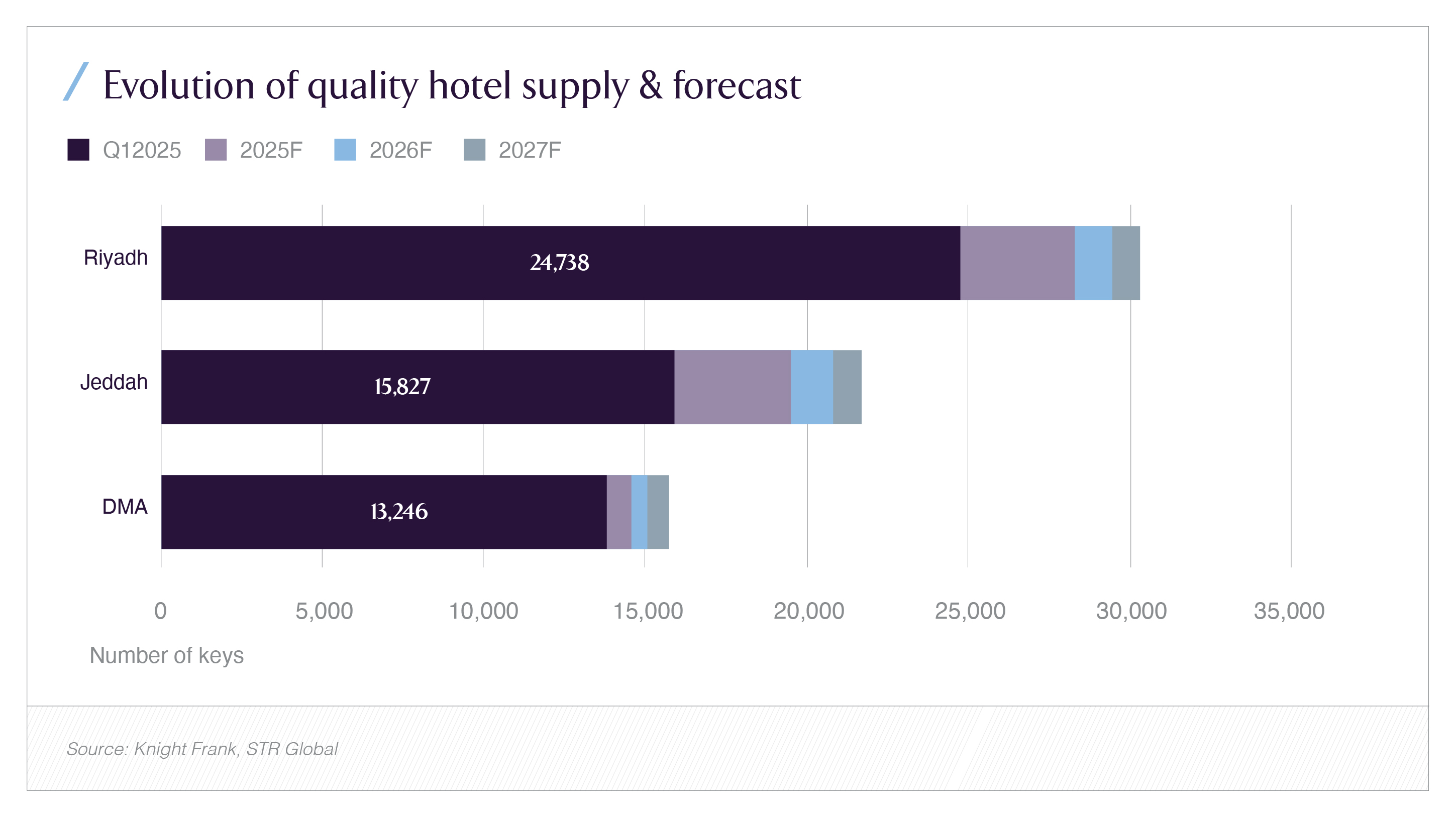
Riyadh, the Kingdom's capital and primary business travel market, is experiencing the most acute performance deterioration of any major Saudi city. According to Knight Frank and STR Global's Q1 2025 data, the capital's ADR fell 8.2% year-on-year to SAR 890, while RevPAR collapsed 17% to SAR 537, with occupancy at 60.3%. JLL's H1 2025 data confirms and extends this trend: Riyadh suffered the steepest performance declines of any Saudi city in the first half of the year, with occupancy falling a further 5 percentage points and ADR declining 6.9% year-on-year. Riyadh added approximately 690 new hotel rooms in H1 2025, bringing its total supply to 49,100 keys, with another 1,080 expected by year-end. The LE Q4 2025 pipeline data shows 107 projects and 20,936 rooms in Riyadh's total pipeline, a record high for the city. This supply pressure is not hypothetical; it is already depressing performance metrics measurably and the pipeline suggests the pressure will intensify.
Jeddah's performance tells a more nuanced but equally cautionary story. Occupancy in Jeddah rose modestly up 1.9 percentage points in H1 2025 but ADR fell a significant 7.1% over the same period, according to JLL. In Q1 2025, Jeddah's ADR declined 11.2% to SAR 627 and RevPAR fell 9.9% to SAR 404. The textbook interpretation of rising occupancy against falling ADR is price discounting by operators attempting to fill rooms in the face of supply competition. This is not a healthy performance pattern; it is a hotel market sacrificing pricing power for occupancy, which generates lower NOI per room and compresses yield for investors underwriting at pre-supply-wave rate assumptions. Jeddah's LE Q4 2025 pipeline stands at 63 projects and 14,358 rooms, with a further 3,616 rooms expected by year-end 2025 and total supply forecast at approximately 21,600 keys by 2027. The supply pressure in Jeddah is real, ongoing, and insufficiently reflected in the aggregate national statistics.
The contrast with the religious corridor is the article's central thesis, and the data makes it decisively. Makkah's hotel market delivered extraordinary Q1 2025 performance: ADR surged 28.9% year-on-year to SAR 859, RevPAR rose 35.7% to SAR 673, and occupancy climbed to 78.3%, a 3.9 percentage point improvement. Madinah outperformed even Makkah on rate, achieving the highest ADR of any city in the Kingdom at SAR 891 up 11.8% year-on-year with RevPAR growing 15.1% to SAR 724 and occupancy at 81.3%. These are the performance metrics of a market with structural supply constraints meeting unrelenting structural demand the precise opposite of the Riyadh and Jeddah dynamic. In 2024, Saudi Arabia welcomed 35.7 million Umrah pilgrims, with 16.9 million international pilgrims a 25% increase from the prior year and the highest international pilgrim count ever recorded. Hajj pilgrim arrivals reached 1.8 million in 2024. Tourist arrivals to Madinah alone are expected to reach 30 million by 2030, up from 15.5 million in 2024, according to the Smart Madinah Authority.
The Structurally Protected Segments: Where Supply Risk Does Not Apply
The religious corridor's structural protection deserves detailed elaboration because understanding why it is protected helps investors identify which other segments share analogous structural characteristics and which do not. Makkah and Madinah benefit from demand that is categorically inelastic in the short-to-medium term. Pilgrimage is a religious obligation for the world's estimated 1.9 billion Muslims, a population growing at approximately 1.8% annually and concentrated disproportionately in high-growth regions such as South and Southeast Asia and Sub-Saharan Africa. Umrah, once quota-constrained, has been progressively liberalized under Vision 2030, with the Saudi government targeting 30 million Umrah pilgrims annually by 2030. The supply pipeline in Makkah 35 projects and 22,829 rooms in the LE Q4 2025 dataset, plus the massive giga-project layer including Rua Al Haram (70,000+ planned keys), Masar Makkah (41,000+ planned keys), and the Makkah cluster of Knowledge Economic City and Thakher will be absorbed by a captive, faith-motivated demand base whose growth trajectory is governed by demographics and religious policy rather than by consumer preference and price sensitivity. More than 252,000 hotel rooms are planned, announced, or under construction in the Holy Cities alone, with 64% in the 4- and 5-star categories. For institutional investors who can access these markets noting that non-Muslim access to Makkah and Madinah investment previously required indirect structures, though Saudi Arabia recently opened listed real estate companies operating in the Holy Cities to international investment this combination of demand inelasticity, government infrastructure investment, and occupancy levels at 78–81% represents a materially superior risk-adjusted return profile to the mainstream Riyadh and Jeddah hotel investment narrative.
The Red Sea eco-luxury segment is the second structurally protected opportunity, though its investment profile is fundamentally different from the religious corridor because the demand it must serve is newly constructed rather than historically proven. The Red Sea Project the PIF-owned development covering 28,000 square kilometers of coastline and islands completed Phase 1 infrastructure in 2024 and has 8,000 hotel rooms across 16 resorts in various stages of development, targeting a categorically distinct leisure traveler: the ultra-high-net-worth international guest drawn by regenerative tourism, pristine marine ecosystem, and architectural distinctiveness. The investment case for Red Sea eco-luxury rests not on near-term occupancy data which will be nascent given the recent opening of initial capacity but on supply scarcity by design (the project has strict environmental constraints on what can be built), brand positioning at price points that generate ADR multiple times higher than typical Saudi urban hotel performance, and the long-duration demand tailwind of a global luxury travel market growing at approximately 7% annually. The risk is execution: delays, cost overruns, and the challenge of delivering a new luxury destination category from scratch. But for investors with patient capital aligned to the 2027–2032 maturation horizon, the combination of sovereign-backed development infrastructure and categorically protected supply creates an entry profile that urban Riyadh or Jeddah luxury hotels simply do not replicate.
Serviced apartments represent the third structurally protected sub-segment, and the most immediately accessible for institutional capital because the product exists, the demand base is established, and the data is clean. GASTAT's Q2 2025 Tourism Establishment Statistics confirmed that serviced apartment occupancy averaged 50.2% nationally in Q2, with Riyadh specifically leading at 57.7% meaningfully higher than the 52.1% recorded for hotels in the same city during the same period. The corporate and long-stay expatriate market driving serviced apartment demand in Riyadh is qualitatively different from the transient hotel guest base that is most exposed to competitive pricing pressure from new supply. Long-stay residents typically relocating corporate employees, regional headquarters staff, and premium residency holders have higher switching costs, lower price elasticity, and a preference for residential-style accommodation that conventional hotel inventory does not serve. Vision 2030's Regional Headquarters Program, which has attracted 780+ licensed companies to Riyadh as of Q3 2025 according to CBRE, and its Premium Residency scheme (which issued 8,074 residency permits in 2024) are structural demand generators for high-quality, long-stay accommodation that will sustain serviced apartment occupancy through the broader hotel supply wave.
Reading RevPAR and ADR as Early Warning Signals
The analytical framework for monitoring Saudi hospitality market health rests on understanding what RevPAR and ADR divergences reveal before the broader market consensus acknowledges the signal. Three diagnostic patterns are worth internalizing.
The first pattern ADR declining while occupancy holds is the most immediately concerning for hotel investors and the most actionable early signal. This is what Jeddah is displaying: operators are accepting lower rates to maintain volume, suggesting that the rate premium previously enjoyed has evaporated and that supply competition has transferred pricing power from operators to guests. For a hotel underwritten on pre-supply-wave ADR assumptions, this pattern is a direct hit to NOI. Investors who entered Jeddah upper-upscale hotels at 2022–2023 ADR levels with debt service calibrated to those projections will find their coverage ratios compressing faster than their occupancy data suggests. The ADR line, not the occupancy line, is the indicator to watch.
The second pattern RevPAR declining faster than ADR occurs when occupancy is falling simultaneously, amplifying the ADR decline to generate disproportionate RevPAR compression. This is what Riyadh is experiencing: a 5-percentage-point occupancy decline in H1 2025 combined with a 6.9% ADR decline produced a RevPAR impact that is the multiplicative product of both. In a leveraged hotel investment context, RevPAR compression at this pace is a material earnings event. Riyadh's pipeline (107 projects/20,936 rooms in Q4 2025 LE data) suggests this pressure is in its early innings, not its final stage. The smart capital in Riyadh hospitality in 2025 is not opening hotels it is identifying distressed assets approaching covenant breaches that will require recapitalization at the trough of the cycle, likely in the 2027–2029 window as the pipeline delivers.
The third pattern RevPAR surging ahead of ADR on volume expansion is the structurally benign signal that characterizes the religious corridor today: Makkah's RevPAR growth of 35.7% is driven primarily by ADR growth of 28.9%, not by occupancy gaming. This is pricing power, not price discounting, and it signals a market where demand is structurally outpacing quality supply. The investment entry point for this type of market is not in the near-term religious corridor assets command premium valuations given their performance but in the medium-term development pipeline, specifically in projects serving the expanding mid-market and affordable pilgrim accommodation need that Knight Frank explicitly identifies as underserved: currently 78% of the pipeline is luxury or upscale, creating a structural gap in the mid-scale and economy segments that the 30 million annual Umrah pilgrim target will necessitate filling.
The Financing Landscape and the Underwriting Discipline Required
For institutional investors, the Saudi hospitality financing environment in 2025 is transitional but improving. Traditional project financing from Saudi and regional banks has been the primary debt vehicle for hotel development, with local lenders Saudi National Bank, Al Rajhi, Riyad Bank providing construction facilities typically at 60–65% loan-to-cost ratios. The absence of a deep hospitality-specific REIT market (Saudi REITs collectively remain thin, with hotel-focused REITs essentially absent) means that exit liquidity for stabilized hotel assets is limited relative to the maturity of comparable markets, reinforcing the importance of conservative entry pricing and conservative NOI assumptions.
The JLL Unlocking Investment Potential in Saudi Arabia's Hotel Industry analysis, published May 2025, documents the emergence of structured investment vehicles targeting the sector, including forward-funded management agreement structures that allow institutional capital to access hotel economics without operational exposure. This model common in UK and German hotel investment is gaining traction in Saudi Arabia as international operators (Marriott, Hilton, IHG, Accor) seek to expand their Saudi footprint without balance sheet commitment, while institutional investors seek income-producing assets backed by recognized operational brands. The management agreement structure is particularly well-suited to the religious corridor sub-market, where brand-affiliated operators can command rate premiums, drive distribution through global loyalty programs, and provide the operational credibility that sovereign and institutional co-investors require.
The underwriting discipline required in this market is more conservative than the national growth narrative suggests. On the demand side, occupancy ramp assumptions for new Riyadh and Jeddah hotels should reflect the competitive environment rather than the market's historical absorption rates: a new luxury hotel opening into a market with 107 projects in the pipeline requires a longer stabilization horizon than peak-cycle projections assume. On the revenue side, ADR underwriting should be grounded in 2025 actuals Riyadh SAR 890, Jeddah SAR 627 not in the 2022–2023 peak rates that justified early-stage feasibility studies. The Expo 2030 demand catalyst is real but concentrated in the second half of 2029 and the first half of 2030, not in the 2025–2027 period when the majority of the pipeline delivers.
The Asset Selection Framework for Disciplined Investors
The article's concluding analytical framework distills the supply and performance analysis into a practical asset selection hierarchy for institutional investors approaching Saudi hospitality.
At the top of the preference hierarchy sit religious corridor assets in Makkah and Madinah specifically, branded 4- and 5-star hotels within walking proximity of Al Haram and the Prophet's Mosque, under long-term management agreements with global operators, with existing stabilized cash flows. These assets are supply-constrained by geography (there is a finite ring of premium land within walking distance of the holy sites), demand-protected by religious obligation, and increasingly accessible to international investment capital under Saudi Arabia's January 2026 foreign ownership reforms. Their pricing reflects their quality, but their return profile structural occupancy above 78%, ADR growing double-digits, and RevPAR growth outpacing every other segment justifies a premium.
The second tier of preference encompasses Red Sea eco-luxury development positions and serviced apartment portfolios in Riyadh's corporate and diplomatic sub-markets. The Red Sea positions carry development risk but offer supply scarcity protection and a premium pricing environment once stabilized. Serviced apartments offer lower return volatility, a corporate tenant base with higher switching costs, and occupancy metrics that are outperforming the broader hotel market as the Riyadh economy deepens.
The third tier, requiring the most rigorous underwriting and the deepest discount to intrinsic value assumptions, encompasses Riyadh and Jeddah upper-upscale hotel development in markets where ADR has already compressed and the pipeline is still delivering. These assets are investable, but only at pricing that reflects the reality of a trough-approaching cycle rather than a peak-cycle narrative.
Conclusion: The Smart Money Does Not Buy the Headline
Saudi Arabia's hospitality market will become one of the world's most significant hotel investment destinations over the next decade. The Vision 2030 demand catalysts are real, the tourism trajectory is structurally supported, and the government's commitment to infrastructure investment is extraordinary in both scale and conviction. None of this means that every hotel in every sub-market will deliver its underwritten return. The 106,521-room pipeline sitting over a base of 167,500 keys is a supply wave of historical proportions, and its concentration in luxury and upper-upscale segments in Riyadh and Jeddah where ADR is already compressing and where 2022 underwriting assumptions are being stress-tested by 2025 actuals is a signal that the market has not yet fully priced.
The investor who disaggregates this market who maps the religious corridor's structural protection, the Red Sea's supply scarcity by design, and the serviced apartment segment's corporate demand resilience against the urban luxury oversupply risk is positioning for alpha in a market that the consensus is trading as a single exposure. Saudi hospitality is not one trade. It is many different trades, and knowing which is which is exactly the analytical work that separates institutional-grade capital from undifferentiated beta buying.




.svg)
