



Putting a Price on the Mismatch
For years, Saudi employers have described the same frustration in different words: the graduates entering the labour market are educated, credentialed, and ambitious and frequently not ready to do the jobs the economy needs done. This was an anecdotal complaint, a recurring theme in HR conversations and boardroom asides, until Pearson's "Lost in Transition" report covered extensively across Saudi business media through May 2026 put a precise economic figure on it. The mismatch between what Saudi Arabia's education system produces and what its labour market demands costs the economy approximately SAR 62 billion annually in lost earnings for Saudi nationals alone, equivalent to 1.34% of 2024 GDP. When non-Saudi workers are included, the drain rises to SAR 196 billion 4.2% of GDP.
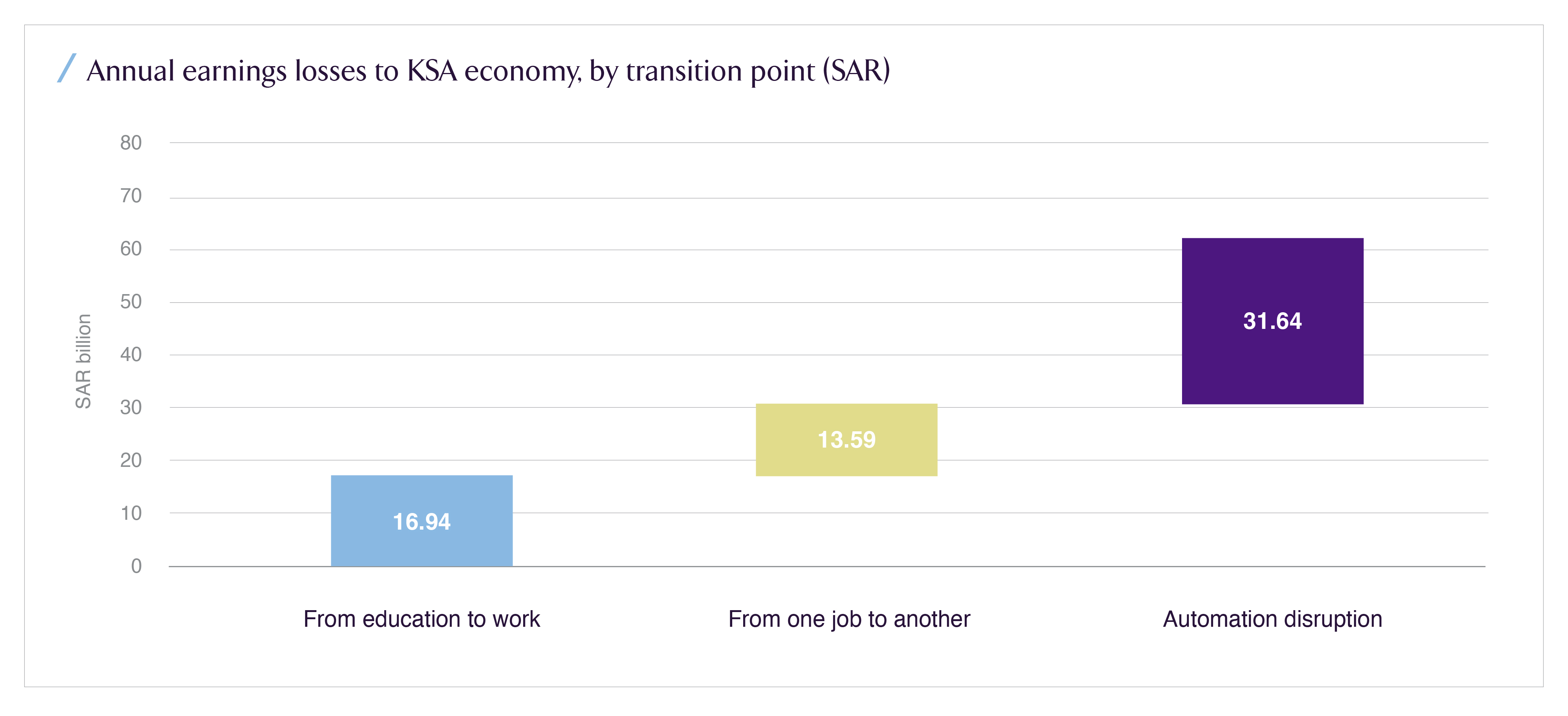
This is not a number that reflects underinvestment in education. The opposite is true: Saudi Arabia has one of the highest education spending commitments of any major economy, gross tertiary enrolment reached 73.8% in 2024, and the Kingdom has built a university system whose flagship institutions dominate the Arab regional rankings. The SAR 62 billion is the cost of misalignment, not the cost of neglecting the economic value that leaks out of the system at the friction points where education fails to translate into productive employment, where displaced workers cannot quickly find new roles, and where the workforce is unprepared for the pace of technological change. Pearson's analysis maps this leakage across three transition points: the move from education to work, the move from one job to another following involuntary separation, and the displacement caused by automation. Of the SAR 62 billion total, automation disruption accounts for the largest share at SAR 16.94 billion, the education-to-work transition for SAR 31.64 billion, and job-to-job transition for SAR 13.59 billion.
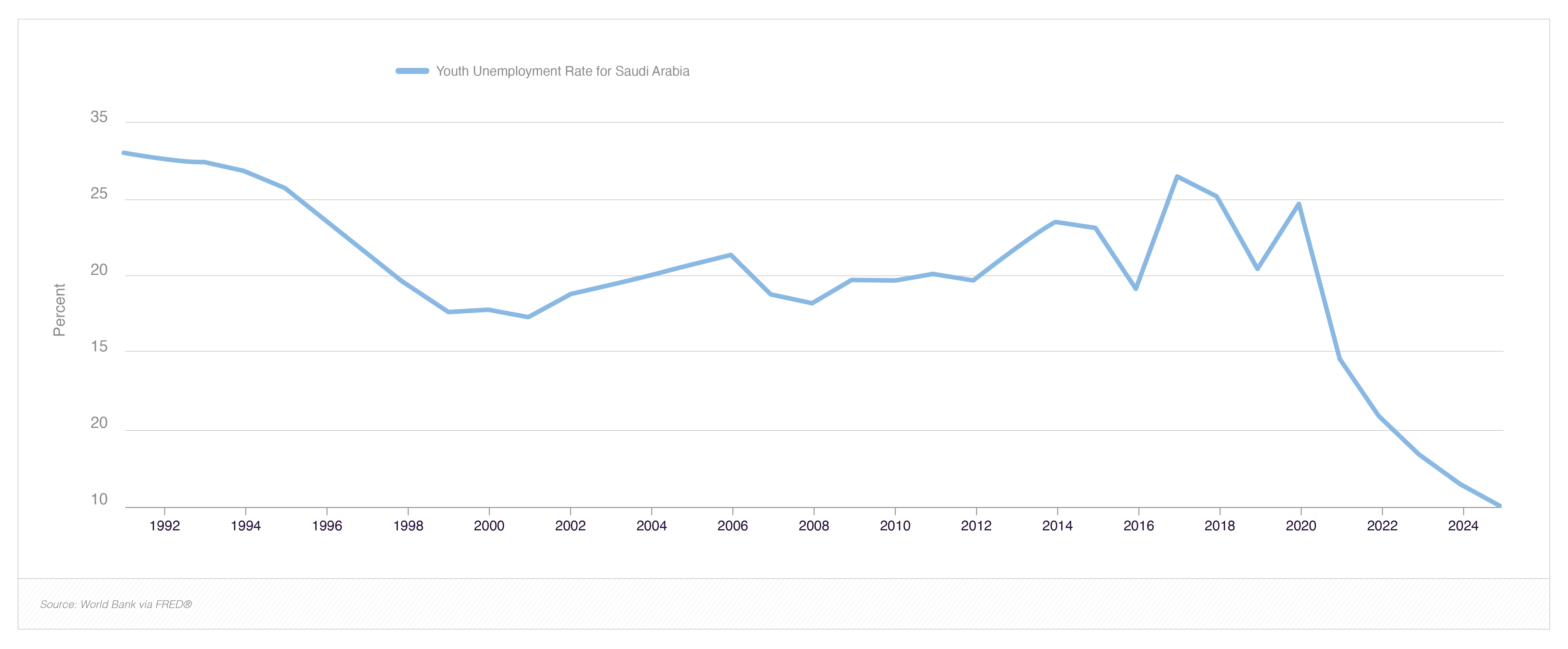
The supporting data is stark and consistent across sources. High school and university graduates take an average of nearly 40 weeks about nine months to secure employment, and only 41% of graduates are employed within 12 months of graduation. Displaced Saudi workers spend an average of 11.3 months unemployed before re-entering the workforce, with around 40% out of work for more than a year. Youth unemployment (ages 15-24) sat at 14.8% in Q1 2025. And the employer side of the equation, captured in Hays's 2026 Salary Guide, is equally telling: 93% of Saudi employers report active skills gaps, with the deficits concentrated in technical and digital skills (49%), business analytics (46%), and industry-specific trade competencies (44%). This article quantifies the gap and its SAR 62 billion price tag, explains the structural causes, identifies which sectors face the most critical shortfalls, and maps the investment opportunity in the human capital solutions the gap is creating.
The Structural Causes: Why the Gap Persists Despite Heavy Investment
The SAR 62 billion gap is not an accident of underfunding, it is the structural product of how Saudi Arabia's education system has developed relative to how its economy has transformed. Three structural causes explain why the mismatch persists, and understanding each is essential to evaluating where human capital investment can most effectively intervene.
The first structural cause is university saturation in traditional fields combined with under-supply in applied and technical disciplines. Saudi Arabia's higher education expansion over the past two decades produced a large volume of graduates, but disproportionately in humanities, social sciences, and general fields that align poorly with the technical, digital, and applied competencies that Vision 2030's diversifying economy demands. The consequence is visible in the data: while Saudi Arabia actually produces a high share of STEM graduates by international comparison 18.1% of degree-level graduates were in STEM in 2022 per OECD data the alignment between specific qualifications and specific labour market needs remains weak. Only 30% of engineering and technology graduates are deemed fully qualified for private sector positions, according to the Pearson analysis. This is not a quantity problem; it is a quality-and-alignment problem. The system produces graduates, but not consistently the job-ready, practically-trained graduates that employers require, because the curricula, the pedagogy, and the absence of mandatory work-integrated learning leave a gap between academic completion and workplace readiness.
The second structural cause is the gender paradox in STEM participation. Saudi women have made extraordinary educational gains they now comprise 58% of all tertiary graduates and, per the Pearson report, 61% of the total graduate pool, with female tertiary gross enrolment reaching 84% in 2024. Yet women's participation in STEM fields remains far below parity at just 14% of STEM graduates at the tertiary level, according to OECD Education at a Glance 2025. This is a profound structural inefficiency: the majority of the Kingdom's most educated emerging talent is concentrated in fields that align least well with the highest-demand, highest-value segments of the labour market. The pattern within STEM is itself revealing Saudi women are well represented in natural sciences and mathematics (UNESCO data shows around 70% of natural sciences, mathematics and statistics graduates were women) but almost entirely absent from engineering, manufacturing, and construction (around 4%). The result is that the rapid feminization of Saudi higher education, which should be a powerful driver of workforce capability, is not translating into the technical and engineering talent pipeline that the economy most acutely needs. This is reflected in employment outcomes: only 29% of women were employed within one year of graduation, compared to 58% of men, though women's employment-to-population ratio has risen impressively from 25.8% in 2021 to 31.2% in 2024.
The third structural cause is the persistent preference for public sector employment. The Saudi labour market has historically been shaped by the expectation of public sector employment to be secure, well-compensated, and prestigious as the default destination for Saudi national graduates. Of the 4.05 million employed Saudi nationals, approximately 29% work in the civil service. This preference creates a structural friction: graduates orient their educational choices and career expectations toward public sector roles that are increasingly capacity-constrained, while the private sector roles that Vision 2030's diversification is creating which require different, more applied and technical competencies go unfilled or are filled by the expatriate workforce that constitutes 77% of total employment. The mismatch is therefore not only between fields of study and job requirements, but between the type of employment graduates expect and the type of employment the economy is generating. Closing the SAR 62 billion gap requires not just realigning skills but realigning expectations toward the private sector roles where the economy's growth and the country's diversification ambitions are concentrated.
Layered on top of these three structural causes is the acute and accelerating challenge of automation. Pearson's analysis identifies that 23% of Saudi jobs are at high risk of automation (rising to 28.5% when the full workforce is included), with automation disruption accounting for the single largest share of the SAR 62 billion in losses. This is the forward-looking dimension of the skills gap: even workers currently well-matched to their roles face displacement as robotic process automation, large-language-model systems, agentic AI, and autonomous robotics reshape the task content of work. The workforce is, in Pearson's framing, "underprepared for the pace of learning needed to keep up with the pace of AI/technology disruption" making continuous reskilling, not just initial education, the central human capital challenge. Reducing reskilling time for automation-affected workers by just 20% could add SAR 6.3 billion in annual earnings.
Which Sectors Face the Most Critical Shortfalls
The skills gap is not uniform across the economy; it concentrates in specific sectors where Vision 2030's growth ambitions collide most directly with the supply constraints of the existing talent pipeline. The Hays 2026 Salary Guide's finding that 93% of Saudi employers report active skills gaps, with deficits concentrated in technical and digital skills (49%), business analytics (46%), and industry-specific trade competencies (44%), maps directly onto the sectors driving the Kingdom's economic transformation.
Technology and digital is the most acute shortfall sector, and the most strategically consequential. Vision 2030's ambition to build a digital economy reflected in the Kingdom's third-place global ranking in the AI Index and first place in cybersecurity per the 2025 Vision 2030 annual report requires a depth of software engineering, data science, AI/ML, cybersecurity, and cloud infrastructure talent that the domestic pipeline cannot currently supply. The 49% of employers reporting technical and digital skills gaps is the single largest deficit category in the Hays data, and it is the area where the gap between the volume of STEM graduates and the specific, current, job-ready digital competencies employers need is widest. The under-representation of women in engineering and ICT (despite their majority in overall tertiary enrolment) compounds this shortfall by leaving the largest pool of educated talent under-deployed in precisely the highest-demand technical fields.
Healthcare is the second critical shortfall sector. The expansion of the healthcare system under the National Health Insurance program, the privatization of hospital capacity, and the digital health transformation all require a depth of clinical, allied health, nursing, health informatics, and biomedical talent that the Kingdom is racing to build. Saudi Arabia employs approximately 26.6 physicians per 10,000 people, below the OECD average, and the workforce development targets graduating more than 10,000 new healthcare professionals annually by 2030 reflect the scale of the gap. Healthcare is a sector where the skills shortfall is not principally one of alignment (the demand for clinical skills is clear) but of pipeline capacity and the specialized training infrastructure required to produce qualified clinical professionals at scale.
Engineering and skilled trades constitute the third critical shortfall, and the one most directly tied to the giga-project construction pipeline. The 44% of employers reporting industry-specific trade competency gaps reflects the acute demand for the practical, applied, technical skills that NEOM, the Red Sea Project, Diriyah, Qiddiya, and the broader Vision 2030 construction and infrastructure agenda require. This is the segment where the TVET (technical and vocational education and training) system is most directly relevant, and where the gap between the academic orientation of much of the higher education system and the applied competencies the economy needs is most visible. Pearson notes that 8% of Saudi employment is in construction, the single largest contributor to automation risk making the construction and engineering trades a sector facing simultaneous current shortfall and future displacement risk.
Business analytics and management is the fourth shortfall sector, capturing the 46% of employers reporting gaps in this category. As the Saudi economy diversifies and the corporate sector deepens, driven by the Regional Headquarters Program's attraction of over 780 multinational regional headquarters to Riyadh the demand for data-driven business analysis, financial modeling, strategic planning, and management capability has surged ahead of the supply of graduates trained in these applied commercial competencies. This is a sector where the mismatch is particularly one of skills-versus-credentials: business and commerce graduates are plentiful, but the specific analytical, quantitative, and decision-support skills that modern corporate roles require are under-supplied.
The Investment Opportunity: Capital Allocating Into Human Capital Solutions
The SAR 62 billion gap is, for investors, a SAR 62 billion addressable market for the solutions that close it. The mismatch between education output and labour market demand creates demand for an entire ecosystem of human capital solutions and Saudi Arabia's combination of acute need, sovereign capital, policy support, and a young, digitally-engaged population makes it one of the most attractive emerging markets globally for human capital investment. The opportunity concentrates in three principal categories.
Corporate upskilling and reskilling platforms represent the most immediately scalable opportunity, driven directly by the automation disruption that constitutes the largest component of the SAR 62 billion gap. With 23% of Saudi jobs at high automation risk and employers reporting near-universal skills gaps, the demand for continuous, workplace-integrated upskilling has moved from a nice-to-have to a business-critical function. The investment opportunity spans enterprise learning platforms, AI-powered skills assessment and personalized learning tools, micro-credentialing and certification providers, and the specialized content and curriculum providers that translate emerging technical competencies into deliverable training. Pearson's own positioning as "the world's lifelong learning company" framing the gap explicitly as a market for skilling solutions signals how major education companies view the commercial opportunity. The model that resonates in the Saudi context is one that shifts, in Pearson's framing, "from qualification-centric learning to skills-centric learning" and "from linear education models to continuous upskilling ecosystems" and the platforms that enable this shift, particularly those that integrate with employer workflows and provide measurable skills outcomes, are positioned to capture sustained enterprise demand.
Workforce readiness and education-to-employment solutions represent the second major opportunity, targeting the SAR 31.64 billion education-to-work transition loss specifically. This category includes the bootcamps, intensive technical training programs, job-placement platforms, and skills-based hiring solutions that compress the 40-week graduate job search and improve the 41% within-12-months employment rate. The model that works addresses the specific gap that Pearson and Hays both identify: the disconnect between academic credentials and job-ready skills. Coding bootcamps, digital skills academies, healthcare training providers, and the apprenticeship and internship platforms that provide the early work experience graduates currently lack are all positioned to capture demand. The Saudi government's explicit policy support Pearson's recommendations align with expanding "internships, apprenticeships, and mentorships that provide early work experience and accelerate movement from classroom to career" provides regulatory tailwind and, in many cases, co-funding through entities like the Human Resources Development Fund (HRDF/Hadaf). For investors, workforce readiness solutions that demonstrate measurable employment outcomes and that align with the high-demand sectors (technology, healthcare, engineering trades) offer the clearest commercial model.
Industry-education partnerships and applied training infrastructure represent the third opportunity, and the one most aligned with the structural reform of the education system itself. This category includes the partnerships between employers and educational institutions that co-design curricula around real labour market needs, the corporate training academies that giga-projects and major employers are building to develop their own talent pipelines, and the specialized applied training infrastructure (simulation centers, technical training facilities, work-integrated learning platforms) that bridge the academic-applied divide. The international branch campus expansion examined in prior Tanmeya analysis is directly relevant here; institutions like the incoming University of New Haven Riyadh campus and the Arizona State University partnership are explicitly oriented toward the applied, employment-linked education model that the skills gap demands. For investors, the opportunity includes co-investment in these education-industry partnership structures, the development of corporate training academy infrastructure, and the platforms that facilitate the curriculum-to-career alignment that Pearson identifies as the central reform need.
The cross-cutting enabler across all three categories is skills intelligence and labour market analytics, the data infrastructure that, as Pearson notes, allows "educators and employers to co-design targeted programmes instead of generic curricula" and enables the shift "from reactive recruitment to predictive workforce planning." Saudi Arabia has the opportunity, in Pearson's framing, "to lead globally in skill intelligence," and the platforms that provide labour market analytics, skills taxonomy and matching, and predictive workforce planning are positioned as the foundational layer on which the broader human capital solutions ecosystem is built. The HRDF's labour market data infrastructure and the GASTAT labour force surveys provide the public-sector data foundation, and the private analytics platforms that translate this into actionable skills intelligence for employers and educators represent an emerging, high-value, and defensible investment category.
The Gaps and Risks in the Human Capital Investment Thesis
For investors building a position in Saudi human capital solutions, three risks warrant specific consideration.
The first is the funding-source concentration risk. Much of the demand for workforce solutions in Saudi Arabia is shaped or subsidized by government entities HRDF/Hadaf, the Human Capability Development Program, and the various Vision 2030 workforce initiatives. This provides powerful demand support and co-funding, but it also concentrates the demand environment around government policy and budget priorities that can shift. Solutions whose commercial model depends substantially on government funding or mandates carry policy risk; those that can demonstrate genuine enterprise demand and willingness-to-pay from private employers have more durable commercial models. Investors should favor solutions with a clear private-sector revenue base alongside any public-sector demand.
The second is the outcome-measurement and quality risk. The workforce solutions market is prone to a proliferation of providers whose training does not demonstrably improve employment outcomes or close real skills gaps. The 30% of engineering graduates deemed job-ready, despite years of education investment, illustrates that credentials and even technical training do not automatically translate into employability. Solutions that cannot demonstrate measurable, employer-validated skills outcomes risk being commoditized or displaced. Investors should prioritize providers with rigorous outcome measurement, employer validation, and demonstrable job-placement or skills-improvement results, the same discipline that distinguishes durable education investments from those that capture short-term subsidy-driven demand without creating lasting value.
The third is the cultural and behavioral adoption risk. Closing the skills gap requires not just supplying solutions but shifting deeply embedded preferences, the orientation toward public sector employment, the field-of-study choices that under-supply technical and engineering talent, and the gender patterns that keep women under-represented in the highest-demand STEM fields. These behavioral shifts are slow, and solutions that depend on rapid changes in graduate preferences or employer hiring practices may face longer adoption curves than commercial models assume. Investors should calibrate their growth expectations to the reality that human capital transformation is a multi-year, behaviorally-mediated process, not a rapid market-capture opportunity.
Conclusion: The Gap Is the Market
Saudi Arabia's SAR 62 billion skills gap is, at its core, a measure of unrealized potential, the economic value that a young, educated, ambitious population is not yet producing because the system that prepares them for work is misaligned with the work the economy needs done. The gap is not the product of insufficient education spending, insufficient talent, or insufficient ambition. It is the product of structural misalignment: between fields of study and labour market demand, between the majority-female graduate pool and the male-dominated technical fields, between the public sector orientation of graduate expectations and the private sector reality of economic growth, and between the static qualifications of initial education and the continuous reskilling that an AI-disrupted economy demands.
For investors, this misalignment is precisely the opportunity. Every dimension of the SAR 62 billion gap corresponds to a category of human capital solution: corporate upskilling platforms for the automation disruption that constitutes the largest loss component, workforce readiness solutions for the 40-week graduate transition, and industry-education partnerships for the structural realignment of education to labour market needs. Saudi Arabia's combination of acute and quantified need, sovereign capital and policy support, a young and digitally-engaged population, and an explicit Vision 2030 mandate to build a high-skill, high-productivity workforce makes it one of the most compelling emerging markets globally for human capital investment.
The Kingdom has built the education system. It has produced graduates, achieved near-universal tertiary enrolment, and made genuine progress on youth unemployment and women's participation. What it has not yet built is the bridge, the connective infrastructure of skills, applied training, continuous reskilling, and labour market alignment that turns educational achievement into economic productivity. That bridge is the SAR 62 billion opportunity. The capital that builds it across upskilling platforms, workforce readiness solutions, industry-education partnerships, and skills intelligence is positioned to capture one of the most strategically significant and policy-supported human capital markets in the world, while doing the work that Vision 2030's entire economic transformation ultimately depends on: ensuring that Saudi Arabia's greatest asset, its young population, becomes the workforce its economy needs.







.svg)
